

80 GHz radar sensors: How FMCW technology improves level and distance measurement
Non-contact radar is an established method for industrial distance measurement and level measurement in environmental, infrastructure and process applications. Modern 80 GHz radar sensors extend its capabilities through stronger beam focusing, high measurement accuracy and reliable performance under demanding conditions. The Endress+Hauser Sensors & Components USR30 radar sensor and UTR30 radar transducer use this technology as flexible platforms for precise measurement solutions.
What is FMCW radar and how does it measure distance?
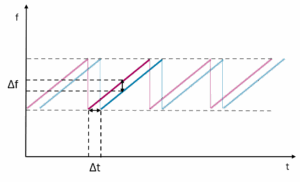 Radar sensor USR30 and radar module UTR30 are based on Frequency Modulated Continuous Wave (FMCW) technology. A FMCW radar continuously transmits a signal, whose frequency changes over time, and compares the transmitted signal with the reflected signal. The resulting frequency difference is proportional to the signal travel time and is used to calculate the distance to the measured surface or object.
In contrast to contacting measurement methods, the acquisition is completely contactless. This means that the measurement remains independent of contamination, corrosion or mechanical wear on the sensor. Especially for fill levels in tanks, silos or bodies of water, this approach offers long-term stability and low maintenance.
Why do modern radar sensors rely on 80 GHz?
Operating frequency strongly influences radar beam geometry. Compared with lower-frequency radar, an 80 GHz radar sensor can produce a narrower, more focused beam with a compact antenna. This directs more measurement energy toward the target and helps the sensor distinguish the desired reflection from echoes caused by surrounding structures.
This higher focus brings several technical advantages:
- Reduction of interfering reflections caused by fixtures, pipelines or vessel walls
- Improved measurement performance in tight installation situations
- Higher signal quality over long distances
- More precise acquisition of small or hard-to-reach measurement targets
These characteristics are one of the main reasons why 80 GHz radar has established itself in modern level and distance measurement technology.
How accurate is an 80 GHz radar sensor?
With an 8° beam angle, radar sensor USR30 concentrates the measurement signal on a defined target area. It supports measuring ranges of up to 35 m and achieves accuracy of up to ±2 mm for liquids.
For metrology, this means:
- High repeatability
- Stable measurement results even with changes in the process
- Precise detection of distance and level changes
- Reliable long-term measurements
Especially in applications such as water level monitoring, storage tanks or silos, even small changes in level can be reliably detected.
Robust against environmental influences
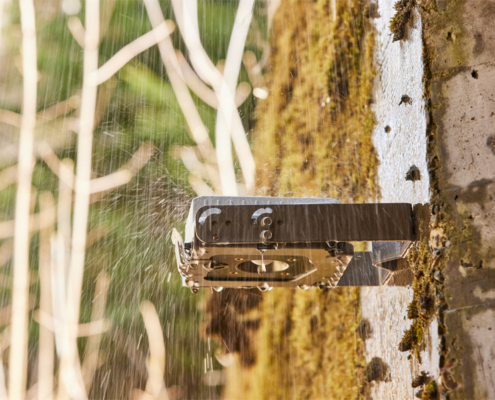
Another technological advantage of radar-based measurement methods is their independence from many environmental influences. Unlike optical methods, radar sensors do not require a clear view without dust, fog or precipitation.
80 GHz radar technology can therefore also be used reliably under changing environmental conditions. Applications benefit in particular from the robustness against:
- Temperature changes
- Precipitation and humidity
- Movements of the medium surface
- Contamination in the measuring environment
These properties make radar the preferred technology for numerous outdoor applications, such as hydrology or gauge stations.
Energy efficiency as an additional technology advantage
In addition to precision and robustness, energy efficiency is playing an increasingly important role. Modern 80 GHz radar sensors such as the USR30 were developed for low energy consumption (32 mW static) and are therefore also suitable for off-grid or battery-powered systems.
This opens up new applications in areas such as:
- Environmental monitoring
- Smart Infrastructure
- Wireless and IIoT Systems
- Mobile measuring stations
The combination of high measurement performance and low energy consumption is a key driver for the increasing spread of radar-based sensor technology.
Conclusion: The technology behind precise readings
The success of modern level and distance measurements today is largely based on the advances in 80 GHz radar technology. High signal focusing, precise distance determination, robustness against environmental influences and low energy consumption enable measurement solutions that work reliably even under demanding conditions.
With the Endress+Hauser Sensors & Components USR30 and UTR30, sensor platforms are available that make these technological advantages usable for a wide range of applications. At the same time, they serve as a flexible basis for customer-specific adjustments. From the integration of a compact sensor to the development of individual measurement solutions, manufacturers can tailor the technology to their own requirements. The radar sensor USR30 and radar module UTR30 thus demonstrate why 80 GHz FMCW radar has established itself as the preferred technology for precise distance and level measurements in many areas.
Discover the radar portfolio!
Further reading recommendations:
“Our Sensors – Your Application: radar sensor for hydrology”
“Looking for an 80GHz radar sensor with stand-alone FCC approval?”